





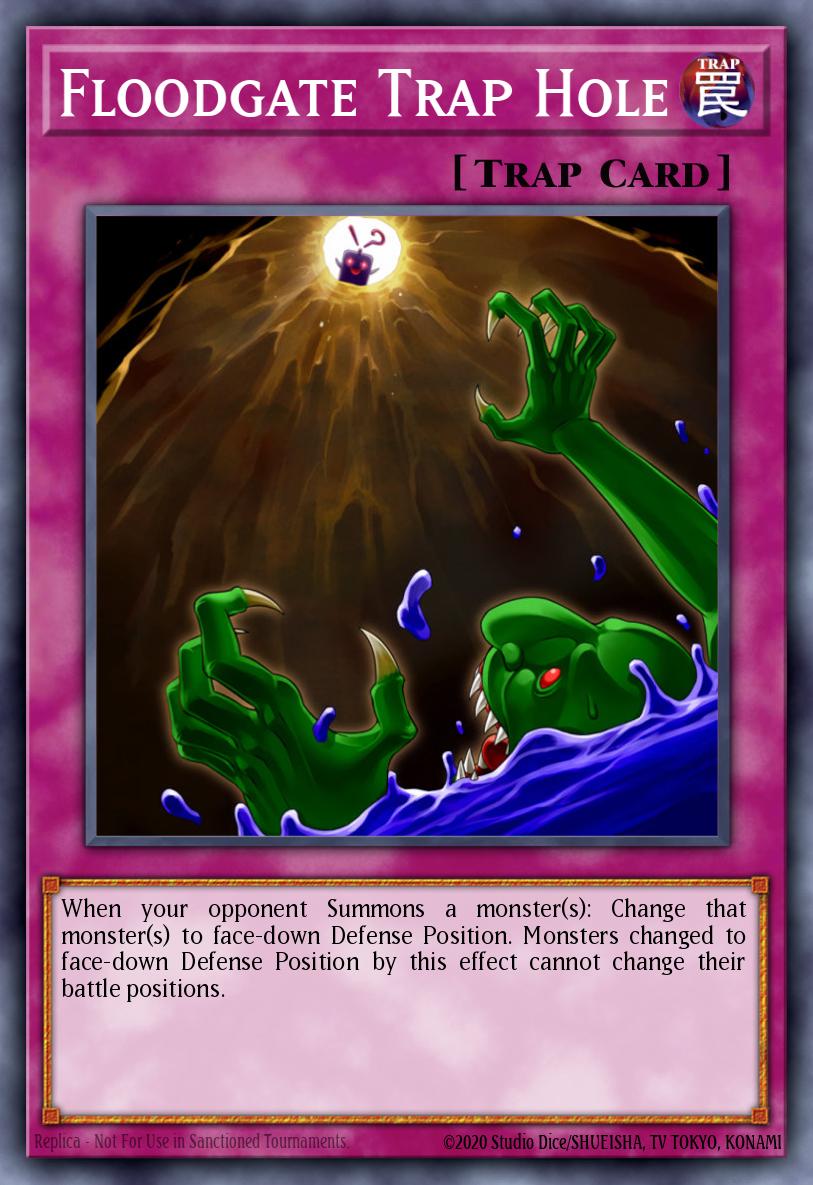

 Trap
 Normal
Floodgate Trap Hole
Archetype:
Hole
View:
7264
When your opponent Summons a monster(s): Change that monster(s) to face-down Defense Position. Monsters changed to face-down Defense Position by this effect cannot change their battle positions.
Floodgate Trap Hole — Power Evaluation
Final Score: 58 ± 6 · Confidence: Medium
- Intrinsic: 55 · Deck: 60.75 · Meta: provisional
- Primary role: Floodgate/Control · Secondary: Board breaker
Why it scores here
Floodgate Trap Hole converts a summon into a board-position change: when the opponent Summons, the summoned monster(s) are set face-down in Defense Position and cannot change battle position. It is a soft interaction with no destruction, negation, or card advantage, so it earns mid-range interaction credit only. It is live in 400 of 400 sampled decks, nearly all Traptrix, and its 3 recorded boards average a power index of 96, but it is never a starter or a body, so that centrality is shared with the deck rather than earned by the card alone. High deck inclusion and board power were not allowed to raise the score beyond what the text supports.
Axis scores
| Axis | Score | Evidence |
|---|---|---|
| Accessibility | 58 | Present in all 400 sampled decks at a 1.28 average copy count, and 3 of 3 combos include it, but the combo evidence records 0 searched or starter appearances, so access is inferred from the Traptrix deck shell rather than from a proven route (observed/inferred). |
| Combo & Conversion | 30 | Recorded boards average power index 96, yet the card is never a starter, searched, or payoff piece in them and adds no bodies of its own, so it only supports boards built by others (observed). |
| Resource Economy | 20 | The text gives no draw, search, refuel, or banish, so it is a one-for-zero response to a summon with no card advantage (verified). |
| Effect & Interaction | 60 | It answers any opponent Summon by repositioning the monster(s) to face-down Defense, which blunts attacks but does not remove or negate the monster (verified). |
| Material Utility | 5 | A Trap card with no monster body, so it cannot serve as material or a name/level provider (verified). |
| Resilience & Flexibility | 40 | It is a face-down Trap that can be negated by generic Trap interruption and gives no follow-up after the summon window; its value is confined to the opponent's Summon timing (inferred). |
| Deck-Building Efficiency | 70 | One copy on average, no garnet or lock, and a generic Trap slot inside a deck that runs it in 100% of samples, which makes it cheap to run (observed). |
Calculation
Weight profile: Floodgate/Control primary; no secondary blend applied (secondary Board breaker recorded but not weighted). Intrinsic ≈ 55, Deck ≈ 60.75, Meta = provisional. Modifiers: none. Final formula: 0.40*Intrinsic + 0.60*Deck
Strengths
- Reliable Summon-timing interaction against any monster summoned by the opponent
- Cheap to run: one copy on average with no garnet or lock
- Deck-proven: appears in all 400 sampled decks and in all 3 recorded boards
Weaknesses
- No card advantage, body, or refuel; a one-for-zero response
- Soft effect: repositions monsters rather than removing or negating them
- Only timed against summons; no value once the opponent is not Summoning
Counters / choke points
- Generic Trap negation or Trap-destruction effects shut the card down before it resolves (inferred; the evidence names no specific counters)
- Opponents who do not Summon in the relevant window take no value from it
Best use
Floodgate/Control trap in Traptrix-style control decks. Decks: Traptrix (archetype 623), Traptrix (archetype 1737), Traptrix (archetype 230), Ragnaraika, Labrynth, Rikka. Suggested copies: 1.
Evidence & gaps
- Verified: Text: opponent's Summons are answered by face-down Defense repositioning, which cannot be reversed by battle position change; Trap card with no monster body, no card advantage in the text; Formats: TCG, OCG, MasterDuel, DuelLinks
- Observed: Present in 400 of 400 sampled decks at 1.28 average copies; Traptrix archetypes account for the bulk of the sampled decks (174 + 44 + 36 + 9 deck counts); 3 of 3 recorded combos include it; average power index 96, average starter count 1; Usage statistics: 100% inclusion in Traptrix (452) and Mimighoul (1821) at typical copies 2-3; 75% in Traptrix (623)
- Inferred: Access comes from the Traptrix shell rather than a demonstrated searcher route; Cross-archetype portability is moderate: 47 distinct archetypes, but concentrated in Traptrix; Its interaction is weaker than a true negation because it only moves the monster
- Data gaps: no banlist token — assumed 3 copies (unlimited) combo sample is 3 boards, so combo centrality is thin no searched-for role or starter role appearances recorded, so accessibility route is inferred decks evidence sample of 400 is largely Traptrix, which limits cross-deck generalisation no dated metagame sample supplied, so meta power is null